
This page lists selected publications, mainly relevant to my research. For a full list of publications I have worked on, you can check out my Google Scholar page.
Generative AI (GenAI) Usage of BLVSPs at the Workplace
Accepted for publication at: ICSE 2026 (To Appear)
Yoonha Cha, Victoria Jackson, Lauren Shu, Stacy Branham, André van der Hoek
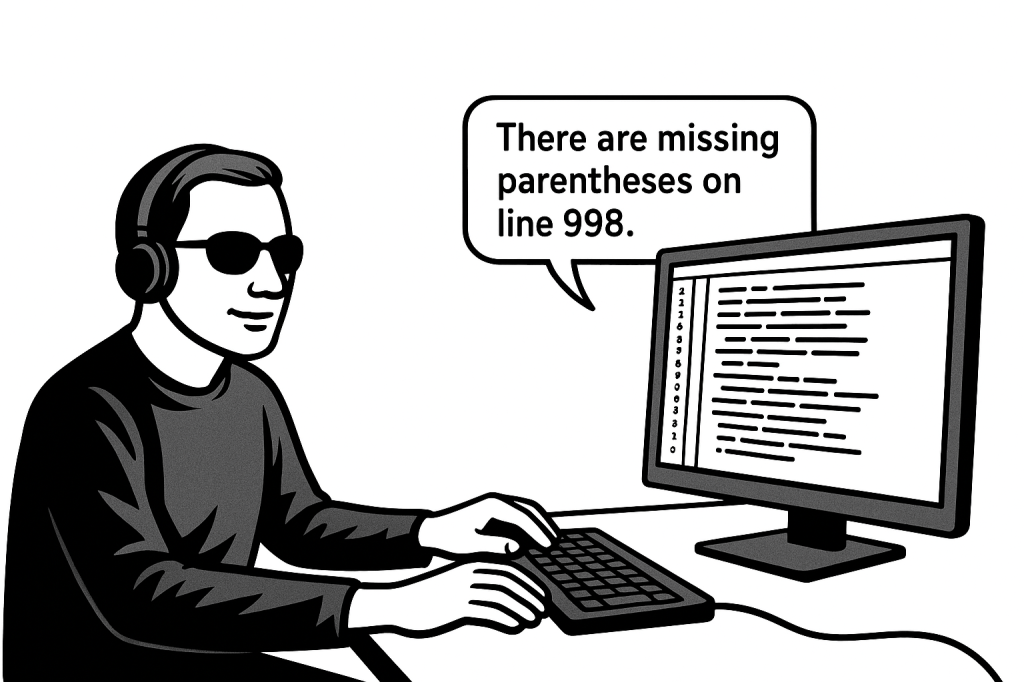
In this project, I explored how blind and low vision software professionals (BLVSPs) used generative AI tools for their software development work.
Abstract: The software development workplace poses numerous technical and collaborative accessibility challenges for blind and low vision software professionals (BLVSPs). Though Generative AI (GenAI) is increasingly adopted within the software development industry and has been a rapidly growing topic of interest in research, to date, the unique perspectives of BLVSPs have yet to be consulted. We report on a qualitative study involving 39 semi-structured interviews with BLVSPs about what the introduction of GenAI has meant for their work. We found that BLVSPs used GenAI for many software development tasks, resulting in benefits such as increased productivity and accessibility. However, significant costs were also accompanied by GenAI use as they were more vulnerable to hallucinations than their sighted colleagues. Sometimes, organizational policies prevented use. Based on our findings, we discuss the higher-risks and higher-returns that BLVSPs had to carefully weigh when deciding whether and when to use GenAI tools for work.
DIY Tool Building of BLVSPs
Published at: CHI 2025 (Honorable Mention Award)
Yoonha Cha, Victoria Jackson, Karina Kohl, Rafael Prikladnicki, André van der Hoek, Stacy Branham
In this project, I explored how blind and low vision software professionals (BLVSPs) build and use do-it-yourself (DIY) solutions for workplace accessibility.
Abstract: Existing commercial and in-house software development tools are often inaccessible to blind and low vision software professionals (BLVSPs), hindering their participation and career growth at work. Building on existing research on Do-It-Yourself (DIY) assistive technologies and customized tools made by programmers, we shed light on the currently unexplored intersection of how DIY tools built and used by BLVSPs support accessible software development. Through semi-structured interviews with 30 BLVSPs, we found that such tools serve many different purposes and are driven by motivations such as desiring to maintain a professional image and a sense of dignity at work. These tools had significant impacts on workplace accessibility and revealed a need for a more centralized community for sharing tools, tips, and tricks. Based on our findings, we introduce the “Double Hacker Dilemma” and highlight a need for developing more effective peer and organizational platforms that support DIY tool sharing.
On the Career Mobility of BLVSPs
Published at: CHASE 2024 (Distinguished Paper Award)
Yoonha Cha, Victoria Jackson, Isabela Figueira, Stacy Branham, André van der Hoek
In this project, I explored how blind and low vision software professionals (BLVSPs) build and use do-it-yourself (DIY) solutions for workplace accessibility.
Abstract: Scholars in the software engineering (SE) research community have investigated career advancement in the software industry. Research topics have included how individual and external factors can impact career mobility of software professionals, and how gender affects career advancement. However, the community has yet to look at career mobility from the lens of accessibility. Specifically, there is a pressing need to illuminate the factors that hinder the career mobility of blind and low vision software professionals (BLVSPs). This study aims to understand aspects of the workplace that impact career mobility for BLVSPs. We interviewed 26 BLVSPs with different roles, years of experience, and industry sectors. Thematic analysis was used to identify common factors related to career mobility. We found four factors that impacted the career mobility of BLVSPs: (1) technical challenges, (2) colleagues’ perceptions of BLVSPs, (3) BLVSPs’ own perceptions on managerial progression, and (4) BLVSPs’ investment in accessibility at the workplace. We suggest implications for tool designers, organizations, and researchers towards fostering more accessible workplaces to support the career mobility of BLVSPs.
Software Development Meeting Accessibility
Published at: CHI 2024
Yoonha Cha, Isabela Figueira, Jessy Ayala, Joshua Garcia, André van der Hoek, Stacy Branham
In this project, I explored how blind and low vision software professionals (BLVSPs) build and use do-it-yourself (DIY) solutions for workplace accessibility.
Abstract: Scholars have investigated numerous barriers to accessible software development tools and processes for Blind and Low Vision (BLV) developers. However, the research community has yet to study the accessibility of software development meetings, which are known to play a crucial role in software development practice. We conducted semi-structured interviews with 26 BLV software professionals about software development meeting accessibility. We found four key themes related to in-person and remote software development meetings: (1) participants observed that certain meeting activities and software tools used in meetings were inaccessible, (2) participants performed additional labor in order to make meetings accessible, (3) participants avoided disclosing their disability during meetings due to fear of career repercussions, (4) participants suggested technical, social and organizational solutions for accessible meetings, including developing their own solutions. We suggest recommendations and design implications for future accessible software development meetings including technical and policy-driven solutions.
 Yoonha Cha